
Foreign investors have pulled out nearly Rs 18,000 crore from Indian equities so far this month, weighed down by escalating US-India trade tensions, disappointing first-quarter corporate earnings, and a weakening Indian rupee. With this, the total outflow by Foreign Portfolio Investors (FPIs) in equities has reached Rs 1.13 lakh crore so far in 2025, according to data from the depositories.

Equity benchmark indices Sensex and Nifty advanced for the third straight session on Tuesday driven by firm global cues and optimism over India-US trade agreement, even as investors turned to profit-booking at higher levels.

The Indian rupee weakened against the US dollar due to rising crude oil prices, geopolitical tensions in the Middle East, and foreign fund outflows.

Stock markets closed higher for the second straight session on Tuesday, driven by gains in bank, IT and capital goods shares.

Indian markets on Dalal Street rallied sharply as easing tensions in the US-Iran conflict and stable oil prices boosted sentiment. Track Nifty 50 and BSE Sensex performance and key global triggers.

There are hopes of a turnaround in overall corporate earnings after six quarters of single digit growth.

Foreign Portfolio Investors (FPIs) remained in a selling mode in January, withdrawing nearly Rs 36,000 crore (about $3.97 billion) as global uncertainties persisted. Meanwhile, a higher securities transaction tax (STT) proposed in the Union Budget may weigh on overseas investor participation in the near future.

Cleaner balance sheets, regulatory support and strong growth prospects helped Indian private banks attract over $6 billion in foreign capital, with more deals expected in 2026.
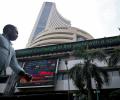
Benchmark stock indices Sensex and Nifty closed on a flat note in a choppy session on Wednesday as gains in PSU banks and auto shares were offset by losses in IT stocks.

Benchmark equity indices Sensex and Nifty tumbled more than 1 per cent on Friday due to across-the-board selloff, especially in metal, IT and commodity stocks, tracking sluggish global markets.

Benchmark equity indices Sensex and Nifty extended their gains for the third straight session on Wednesday, driven by last-hour buying in bank, metal, and FMCG shares.

Precious metal prices, particularly gold and silver, experienced a significant surge in the national capital as investors sought safe-haven assets amid escalating hostilities in the Middle East.

The rupee witnessed a volatile trading session and settled for the day on a slightly lower note, down 1 paisa at 90.66 against the US dollar on Monday, as traders assessed the details of the India-US interim trade framework.

For decades, multinational pharmaceutical companies and Indian drugmakers worked in ways that supported each other: MNCs brought innovation and brands, while Indian companies built scale through generics and cost efficiency. There was an important overlap - generic drugs - but this is shrinking fast. And the consequences are reshaping India's gigantic pharmaceutical market.

From the Sensex firms, Tata Steel tanked the most by 4.57 per cent. ICICI Bank, Power Grid, HCL Tech, Tech Mahindra, Infosys and Kotak Mahindra Bank were also among the laggards. Mahindra & Mahindra, State Bank of India, ITC and Bharat Electronics were among the gainers.

Stock markets rebounded on Friday with the benchmark Sensex closing higher by 316 points after heavy buying in banking and metal shares amid optimism over trade deal progresses and India's participation in Pax Silica.

Benchmark Sensex tumbled 1,236 points or 1.5 per cent while Nifty closed near 25,450 on Thursday following an across-the-board sell-off amid escalating geopolitical tensions between the US and Iran.

Households should moderate large discretionary expenses for the time being.
'They should prioritise essential spending. They should maintain an emergency fund covering 6 to 12 months of expenses.'

Benchmark indices Sensex and Nifty ended lower on Thursday, snapping a three-day rally, amid a weak trend in global stock markets.
Benchmark equity indices Sensex and Nifty rebounded on Thursday after three sessions of losses, tracking gains in global markets after US President Donald Trump struck a conciliatory tone on Greenland. In a volatile session, the 30-share BSE Sensex climbed 397.74 points, or 0.49 per cent, to close at 82,307.37.

Foreign investors offloaded Indian equities worth nearly Rs 21,000 crore in the first half of August, pressured by US-India trade tensions, lacklustre first-quarter corporate earnings, and a weakening rupee.

After withdrawing money on a net basis for the past three months, foreign portfolio investors (FPIs) have turned buyers with a Rs 6,480 crore investment in October so far, driven by strong macroeconomic factors.
Indian equity markets closed higher, driven by gains in PSU bank, auto, and financial stocks, following the US Supreme Court's decision on tariffs. Sensex climbed 479.95 points to 83,294.66, and Nifty advanced 141.75 points to 25,713.

Foreign investors continue to show confidence in the country's equity market, infusing Rs 18,620 crore so far this month, driven by a combination of global tailwinds and improving domestic fundamentals. This positive momentum follows a net investment of Rs 4,223 crore in April, marking the first inflow in three months, data with the depositories showed.
Benchmark equity indices Sensex and Nifty extended their gains for the second straight session on Monday, driven by optimism over the India-US trade deal and robust buying in public sector banks, consumer durables, and realty stocks.

Stock market is gearing up for an eventful week ahead where key triggers such as quarterly earnings from corporates, the US Fed interest rate decision and the upcoming Union Budget for 2026-27 would grab the limelight, analysts said.

Reliance holds 67.03% of Jio Platforms Limited and the public listing would provide an exit to many investors.

The rupee declined 31 paise to settle at 90.65 against the US dollar on Friday, weighed down by geopolitical uncertainties over the US-Iran talks, and a sharp rise in global crude oil prices.

Foreign investors continue to show confidence in the country's equity market, infusing Rs 14,167 crore so far this month, largely driven by favourable global cues and robust domestic fundamentals. Notably, this inflow has come despite the ongoing military tensions between India and Pakistan.
Stock markets closed higher on Friday after the Reserve Bank of India kept its benchmark interest rate unchanged as expected and proposed allowing banks to lend to Real Estate Investment Trusts (REITs) with certain prudential safeguards to deepen the financing pool for the real estate sector.

Overseas consultant NNS Chandra offers advice on how to pick the right international education for you.

'Multi-asset funds have cornered 30 per cent of hybrid fund inflows in 2025, reflecting a growing preference for diversified portfolios that combine equity, debt and commodities.'

The net inflow into equity mutual funds surged 24 per cent to Rs 23,587 crore in June, reversing the declining trend of the last five months, driven by strong equity market performance across segments, data released by the Association of Mutual Funds in India (AMFI) showed on Wednesday. Also, the latest fund infusion by investors marks the 52nd consecutive month of net inflows into the segment.

Stock market benchmark indices Sensex and Nifty ended 2.5 per cent higher on Tuesday after India and the US agreed to a trade deal under which Washington will bring down the reciprocal tariff on Indian goods to 18 per cent.

Restoring weighted tax deductions and adopting a petty patents regime can foster firm-level innovative activity critical for competitiveness, points out Nagesh Kumar.

Benchmark stock indices Sensex and Nifty dived sharply by nearly 2 per cent on Sunday after Finance Minister Nirmala Sitharaman proposed a hike in the Securities Transaction Tax (STT) on derivatives. Reversing the early gains, the 30-share BSE Sensex plunged sharply by 2,370.36 points or 2.88 per cent to slide below the 80,000-mark at 79,899.42 in afternoon trade as the finance minister announced a hike in STT on futures contracts to 0.05 per cent from the current 0.02 per cent.

Platform-style partnerships between global investors and Indian developers are expected to gain further traction over the next few years. This comes as institutional capital increasingly shifts from one-off asset acquisitions to scalable, long-term strategies.

Even as the benchmark and broader indices were down sharply on Monday due to escalating tensions in West Asia, the Nifty Defence index ended the session in the green.

Top Indian cement firms are expected to report a strong earnings growth for the second quarter of the financial year 2025-26 (Q2FY26) on a year-on-year (Y-o-Y) basis, amid improved realisations, prices, and steady volume growth, but on a low base.

Flexicap fund performance depends heavily on the fund manager's decisions.
